
A Snapshot of Investor Behavior During a Downturn
The courage to stay the course
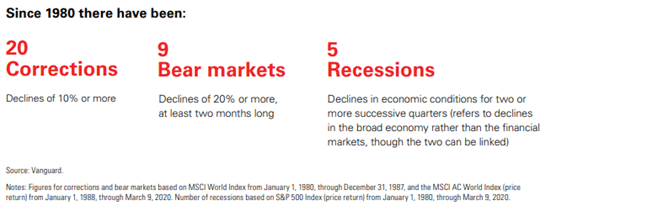
We’ve long professed that short-term market movements—whether up or down—should not dictate one’s investment strategy. Our data shows that our own clients agree as we had little effort with keeping the overwhelming majority staying the course through the recent volatility. Less than 0.5% of clients abandoned their portfolios and had us move entirely to cash. A willingness to weather sudden market drops is an important part of long-term investing. Although it is a natural instinct to seek to preserve capital when the market drops precipitously, too often investors remain on the sidelines and miss the inevitable recovery.
Back in March, we reminded clients to stay the course. Even better, about 20% of our clients were rebalanced into the storm, buying equities, and regaining their targeted asset allocations. This rebalancing helps mitigate risk, and it is a staple of our advice and an effective way to “buy low and sell high”
Why is staying the course so important? As an extreme example, consider the investor who lost faith in the markets and cashed out on March 23, the low point in the U.S. stock market. Stocks subsequently rebounded more than 39% over the next three months; the unfortunate individual who moved to a money market fund earned a meager 0.14%. YTD (Year to Date), our clients returns are ranging between 3 to 9% while staying comfortably diversified in custom portfolios thoroughly designed to meet each of your unique goals and individual needs.
Today’s Trivia:
Pershing, a subsidiary of The Bank of New York Mellon Corporation, commonly known as BNY Mellon, is an American multinational investment banking services holding company headquartered in New York City. BNY Mellon was formed from the merger of The Bank of New York and the Mellon Financial Corporation in 2007. It is the world’s largest custodian bank and asset servicing company, with $1.9 trillion in assets under management and $37.2 trillion in assets under custody as of the second quarter of 2020. BNY Mellon is incorporated in Delaware.

Through its Bank of New York predecessor, it is one of the three oldest banking corporations in the United States, and among the oldest banks in the world, having been established in June 1784 by a group that included American Founding Fathers Alexander Hamilton and Aaron Burr. Mellon had been founded in 1869 by the Mellon family of Pittsburgh, which included Secretary of the Treasury.
Even keeled at all times
Just as investors should stay even keeled during downturns, they should ignore the euphoria of a sudden surge in the market and the fear of missing out on easy gains. One byproduct of the market churn is the renaissance of day trading among individual investors. Online brokerage platforms saw new accounts spike in the early part of 2020, with many of these investors looking to capitalize on “hot” stocks or engage in speculative moves. We have seen this movie before and know how it ends, for those not understanding how investing works as they pay for an expensive lesson in diversification.
Question: Do corporations pay taxes?
Short answer is mostly. The profits retained by corporations are taxed at 21%, the remaining must paid out as dividends.
Some corporations have sustained periods of losses that can be carried forward to offset their future profits.
What Are Dividends?
The most common dividends are the distributions of profits that a corporation pays to its shareholders.
All dividends are taxable and all dividend income must be reported by the shareholders.
Last year, US companies shelled out $1.4 trillion in dividend income to their stockholders, who as owners, pay the taxes on the distributed profits.
There is no guarantee investment strategies will be successful. Investing involves risks including possible loss of principal. Diversification does not eliminate the risk of market loss.
All expressions of opinion are subject to change. This article is distributed for informational purposes, and it is not to be construed as an offer, solicitation, recommendation, or endorsement of any particular security, products, or services.
View the MISSION STATEMENT of McIlrath & Eck and find out how we can help you make sense of the latest financial news and economic cycles as our fee-only advisors work closely with you to develop and maintain a well-planned retirement strategy.